Categories
Add Resources - Quality Assurance & Policy

Global genomic surveillance strategy for pathogens with pandemic and epidemic potential, 2022–2032

Looking at the decade 2022-2032, WHO presents a global genomic surveillance strategy for pathogens with pandemic and epidemic potential.

The goal is to strengthen and scale surveillance of these pathogens to enable quality, timely and appropriate public health actions across local to global surveillance systems.

WHO’s strategy outlines five objectives with accompanying actions that need implementation plans.

It also highlights considerations to build global genomic surveillance over the next 10 years, as well as monitoring and evaluation mechanisms.

The report includes two annexes:

  • Strategy development and stakeholder engagement
  • Key WHO assets for the strategy.

Read report here

Categories
Add Resources - Quality Assurance & Policy

Genomic sequencing of SARS-CoV-2: a guide to implementation for maximum impact on public health, 8 January 2021

WHO released its publication, Genomic sequencing of SARS-CoV-2: a guide to implementation for maximum impact on public health, on 8 January 2021.

As the genomes of SARS-CoV-2 are able to be sequenced almost within real time, this enables increased speed to inform public health responses.

This has led to more laboratories investing in viral genome sequencing. Before starting such a programme, however, the intended goals of sequencing must be understood and a strategy for analysis in place, as well as a plan for how findings will be used.

Decisions about sequencing goals should be made in a multidisciplinary framework that includes representatives of all stakeholders. Funding sources must also be identified, and ethical aspects evaluated.

To maximize public health impact, usable and timely results need to be produced and communicated.

This document, available in English and Portuguese, provides this type of guidance for laboratories on maximizing the impact of SARS-CoV-2 sequencing activities now and in the future.

Read the guide here


Categories
Featured Work - Procurement & Supply Management Featured Work - Quality Assurance & Policy

WHO product, policy and standards related to COVID-19

WHO’s health products policy and standards team supports countries to formulate evidence-based policies, and to ensure good practice and good governance throughout the supply chain.

Its work includes the Essential Diagnostic List (EDL), which aims to provide evidence-based guidance. The EDL is a reference for the development or update of national lists of essential in vitro diagnostic tests.

There are infographics and video clips available to explain the use of the EDL and the importance of diagnostics.

The health products policy and standards team also supports countries on access to health products for COVID-19

It works with the (ACT) Accelerator to enhance the development, manufacture, procurement and distribution of COVID-19 treatments for populations in low- and middle-income countries. This include medicines, vaccines, medical devices, and in vitro diagnostics. 

The WHO’s Disease Commodity Packages (DCPs) are a series of disease specific datasheets that list the critical commodities and the technical specifications for each commodity per disease. This overview includes links to DCPs for various diseases, including COVID-19, which may be downloaded.


Categories
Add Resources - Procurement & Supply Management

COVID-19 Diagnostics Dashboards

A COVID-19 diagnostics dashboard providing information for data-driven procurement and purchasing has been developed by PATH. 

The dashboard consolidates publicly available market intelligence to ensure that decision-makers in national governments, procurement specialists, funders, and policymakers have the data they need.


Categories
Add Resources - Procurement & Supply Management

Global Fund’s list of diagnostic tools eligible for procuremen

Here is a list of SARS-CoV-2 Diagnostic test kits and equipment eligible for procurement according to Board Decision on Additional Support for Country Responses to COVID-19. 

Why use them?

It is simpler and provides faster results than laboratory tests (PCR tests). 

How does it work?

These tests detect viral proteins from the SARS-CoV2 virus in a swab taken from the nose and other respiratory secretions. 

How fast is it?

Results are ready in around 30 minutes. 

How accurate are they?

These tests are less sensitive than PCR tests but are ideal in situations where there is a need for rapid, inexpensive, and early detection of the most infectious COVID-19 cases.

What guidance is provided by the WHO for the use of these tests?

Rapid antigen tests are ideal for primary case detection in symptomatic individuals suspected to be infected. Health workers can also use the test to ascertain the status of asymptomatic individuals at high risk of COVID-19. It is an excellent tool for contact tracing during outbreak investigations and monitoring trends of disease incidence in communities.


Categories
Featured Work - Manufacturing

Outline of WHO’s C-TAP platform

The COVID-19 Technology Access Pool (C-TAP) provides a platform for developers of COVID-19 therapeutics, diagnostics, vaccines and other health products to voluntarily share their intellectual property, knowledge, and data, with quality-assured manufacturers. 

It was launched in May 2020 by WHO, the Government of Costa Rica and other partners to facilitate faster equitable and affordable access to COVID-19 health products for all countries.

Currently endorsed by 45 WHO Member States, it is a response to the global Solidarity Call to Action. Its implementing partners include UNDP, the Medicines Patent Pool, the UN Technology Bank and Unitaid.

C-TAP provides a single global platform that includes public health-driven, transparent, voluntary, non-exclusive and transparent licences. 

Read more on C-TAP here


Categories
Featured Work - Awareness & Advocacy

EPI-WIN: Science for communities during health emergencies

WHO has established the Information Network for Epidemics (EPI-WIN) to provide timely scientific information on health emergencies and to co-create solutions through dialogue with affected communities.

EPI-WIN technical information includes updates and links to webinars, youth engagement, the COVID-19 infodemic and a COVID-19 transmission package.

Areas of work include:

  • Innovation for engagement
  • Networks
  • Norms and standards
  • Infodemic management.

This work involves translating science for better health emergency preparedness, and strengthening partnerships in the faith community.

Read more here


Categories
Add Resources - Awareness & Advocacy

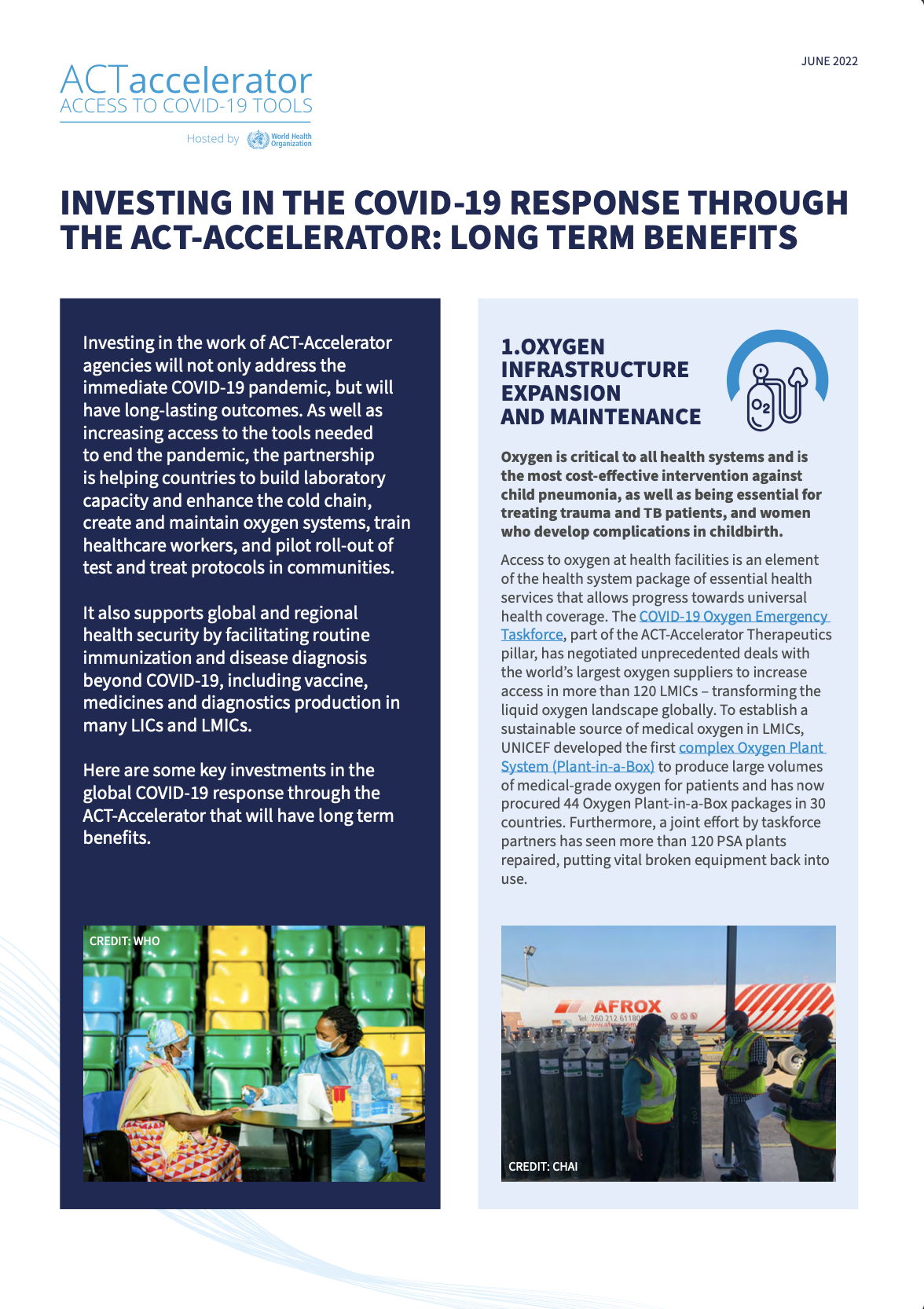
Investing in the COVID-19 Response through the ACT-Accelerator: Long-Term Benefits

This brief report covers the work of ACT-Accelerator agencies in not only addressing the immediate COVID-19 pandemic, but also providing long-lasting outcomes. 

Alongside increasing access to the tools needed to end the pandemic, the partnership is helping countries to build laboratory capacity and enhance the cold chain, create and maintain oxygen systems, train healthcare workers, and pilot the roll-out of test and treat protocols in communities.

This document outlines key investments in the global COVID-19 response through the ACT Accelerator that will have long-term benefits such as:

  • Strengthening the health workforce
  • Building surveillance systems
  • Boosting local manufacturing and technology transfer
  • Empowering healthcare workers to rapidly and accurately diagnose and treat patients not only for COVID-19, but also for other diseases.

Read the full document here


Categories
Resource Centre - Publications

SARS-CoV-2 VOCs, Mutational diversity and clinical outcome: Are they modulating drug efficacy by altered binding strength?

The global COVID-19 pandemic continues due to emerging Severe Acute Respiratory syndrome coronavirus 2 (SARS-CoV-2) variants of concern (VOC). Here, we performed comprehensive analysis of in-house sequenced SARS-CoV-2 genome mutations dynamics in the patients infected with the VOCs – Delta and Omicron, within Recovered and Mortality patients. Statistical analysis highlighted significant mutations – T4685A, N4992N, and G5063S in RdRp; T19R in NTD spike; K444N and N532H in RBD spike, associated with Delta mortality. Mutations, T19I in NTD spike, Q493R and N440K in the RBD spike were significantly associated with Omicron mortality. We performed molecular docking for possible effect of significant mutations on the binding of Remdesivir. We found that Remdesivir showed less binding efficacy with the mutant Spike protein of both Delta and Omicron mortality compared to recovered patients. This indicates that mortality associated mutations could have a modulatory effect on drug binding which could be associated with disease outcome.

Download Document


Categories
Resource Centre - Publications

Mutational dynamics across VOCs in International travellers and Community transmission underscores importance of Spike-ACE2 interaction

Highlights

  • The mutational landscape of 1567 international travellers and community transmission were characterized across VOCs in India
  • Mutations in LD for VOCs demonstrated differentially altered binding affinity and electrostatic interactions of Spike-ACE2.•
  • Altered Spike-ACE2 affinity among VOCs predicted sudden takeover of Delta over Alpha and BA.2 over BA.1 in India.

Download Document