Categories
Featured Work - Scaling Up & Sustainability

COVID-19 Ag RDT training package for community healthcare workers

The SARS-CoV-2 antigen rapid diagnostic test community health worker (SARS-CoV-2 Ag RDT CHW) training package is a structured, comprehensive collection of training resources and tools.

It aims to support institutions to organize, run and evaluate training of trainers and/or training of CHWs who will be performing SARS-CoV-2 testing using Ag RDTs.

The package can be used in face-to-face training or as a blend of remote face-to-face training. Materials can be adapted and customized based on national guidelines and participant target groups.

Training addresses the theoretical and practical components of SARS-CoV-2 Ag RDT testing and provides CHW trainees with the skills for, and resources on, how to safely perform SARS-CoV-2 Ag RDT tests. It does not intend to address the implementation of Ag RDT testing across the diagnostic network.

The materials for the training package are freely available to download, with links to material for facilitators provided in the document.

Access training package here

Categories
Add Resources - Scaling Up & Sustainability

Improving diagnostic data systems in Ecuador

This training report outlines a project to improve COVID-19 diagnostic data systems in Ecuador by the Clinton Health Access Initiative (CHAI) project and FIND. 


The project was geared to improve diagnostic data systems by training programme staff and other COVID-19 data users involved in data management in health facilities. 

The COVID-19 Information Systems Strengthening workshop was held in venues across nine zones in Ecuador, spread across several provinces and in various cities.

In all the workshops, the attendees agreed that there was a need for decentralization in the

processing and visualization of information. 

With the view that national staff are better trained than the zone or district staff, participants also suggested the Ecuador Ministry of Health develop a training plan for technical personnel in the regions to update their knowledge.

Read more here

Categories
Add Resources - Scaling Up & Sustainability

CHAI-FIND project to improve COVID-19 diagnostic data systems

This training report outlines a project to improve COVID-19 diagnostic data systems, first in Rwanda and later in Ecuador, by the Clinton Health Access Initiative (CHAI) project and FIND. 

The project had three main workstreams:

  • Developing an analytical system
  • Integrating COVID-19 data systems with other relevant data systems
  • Upgrading and optimizing the COVID-19 data system.


The training report is geared to improve diagnostic data systems and automate approaches that were previously manual. 

The activity aimed to train programme staff and other COVID-19 data users involved in data management in health facilities. 

For those involved in the training, management and analysis of COVID-19 data has improved. The system is capable of inter-operating with other systems, leveraging COVID-19 data more effectively, and handling large amounts of data from multiple sources. 

The Rwanda Ministry of Health, in conjunction with CHAI-FIND and the Rwanda Biomedical Centre, has released a step-by-step guide to the training.

Read more here

Categories
Add Resources - Scaling Up & Sustainability

Rwanda study shows community health workers support digital tools and RDTs for COVID-19 testing

This Rwanda Biomedical Centre presentation, part of the second International Conference on Public Health in Africa (CPHIA 2022), assessed aspects of SARS-CoV-2 testing in Rwanda.

The study aimed specifically to evaluate how community health workers (CHWs) used antigen-detecting rapid diagnostic tests (Ag RDTs) alongside a clinical screening digital tool (e-ASCOV) at household level to test for COVID-19 at household level.

It selected 800 CHWs across eight districts in Rwanda to participate, asking them how they perceived their role in delivering care, as well as the experience of the clients.

Most participants (83.4%) reported that the e-ASCOV app was easy to use. Most (89.6%) also reported that nasal RDT was easy to administer, and the results easy to read.

Key findings

All the CHWs supported the use of digital tools and RDTs for COVID-19 testing. Most participants (83.4%) reported that the e-ASCOV app was easy to use. Most (89.6%) also reported that nasal RDT was easy to administer, and the results easy to read.

These results highlight that it is possible to implement COVID-19 testing at household-level, to support community-based surveillance for early case detection and management.

The study showed the potential to use similar digital tools for other diseases to support healthcare services delivery closer to the community, and for evidence-based decision making.

It also suggests that the programme needs to be scaled up to train other CHWs and extend the e-ASCov to malaria, TB, and other diseases.

Read more here

Categories
Add Resources - Scaling Up & Sustainability

Nairobi’s boda-boda riders take part in COVID-19 study

This discussion brief for a FIND and Jomo Kenyatta University of Agriculture and Technology (JKUAT) dissemination meeting on May 2021 focused on the riders of bicycles and motorcycle taxis, commonly known as boda bodas, in Nairobi, Kenya.

The operational research study used digital solutions, in conjunction with Ag-RDTs, to support decentralized COVID-19 and TB testing and linkage to healthcare of the subjects. 

It aimed to:

  • Create demand for testing among boda-boda riders.
  • Identify potential cases of COVID-19 and TB using a digital screening tool and link them to testing and care.
  • Measure COVID-19 and TB positivity rates among boda-boda riders.
  • Evaluate the performance of the Ag-RDT against RT-PCR.
  • Assess the effectiveness of the digital tool for comprehensive data capture.

The study was implemented jointly by JKUAT and MoH, in four counties: Machakos, Kiambu, Nairobi and Kajiado. 

The Boda-Boda Safety Association of Kenya (BAK) played an indispensable role in demand creation, and digital messaging was also used for sensitization. 

A total of 5,663 boda-boda riders enrolled in the study, all of whom received a general medical check that included measuring blood pressure and blood sugar.

There was high demand for community-based testing services not only among riders, but also from passers-by.

Following digital screening for COVID-19 and TB symptoms, 4,946 participants were selected for COVID-19 testing, with 372 of these also tested for TB .

Significant findings

Notable findings include:

  • A high prevalence of non-communicable diseases, and a relatively low national health insurance coverage, with 42% of riders having elevated blood pressure, and 48% abnormal blood sugar.
  • An overall COVID-19 positivity rate of 1% was found among those tested with Ag-RDTs. Of the participants who also received a PCR test, the overall positivity rate was 5%. There were differences between the four counties.
  • Of those tested for TB, no cases of COVID-19 and TB co-infections were found. However, more than half the participants reported respiratory symptoms.

What are the recommendations?

  • There is strong interest in, and uptake of, diagnostic services at community level, which could be leveraged to expand access to testing.
  • Integration of COVID-19 screening with screening for other respiratory diseases, such as TB, can optimize the value of community-based testing.
  • Boda-boda riders should be a priority group for health interventions.
  • Digital solutions can enhance delivery of decentralized diagnosis.

Read full report here
Categories
Add Resources - Scaling Up & Sustainability

FIND partners with CSIR-IGIB to strengthen SARS-CoV-2 genomic surveillance in India

FIND has partnered with CSIR-IGIB (Institute of Genomics and Integrated Biology) to help India fight COVID-19 by boosting sequencing capacity across the country. 

The partnership aims to decentralize genomic surveillance of SARS-CoV-2 by setting up “MicroLabs”. These will enable sequencing, analysis and interpretation of sequencing data with minimal turnaround time and infrastructure limited settings.

The goal is to optimize and scale the capacity needed to identify SARS-CoV-2 variants of concern (VOC) and variants of interest (VOI).

The partnership will also  identify genomic hotspots and mutations associated with disease severity that are critical for surveillance and public health action.

Read the report here

Categories
Add Resources - Research & Development

Collaborations lead to apps, toolkits to collect COVID-19 RDT data

Collaboration between organizations is essential to quickly design and develop human-centred health tools to tackle the COVID-19 pandemic. The list below is a collection of various applications and toolkits developed in this way to capture COVID-19 related data.

  1. The COVID-19 Template App, designed by FIND and Dimagi, supports health workers as they administer and record the results of COVID-19 antigen rapid diagnostic tests (RDTs). The application features workflows for patient registration, test initiation, and result capture. 
  1. The RDToolkit: Currently Supported RDTs is a listing of the RDTs that the Rapid Diagnostics Tookit hosts.
  1. FIND and HISP India collaborated to develop a DHIS2-based package for capturing data for RDTs. The resultant COVID-19 RDT Data Capture programme metadata package is available for download.
  1. As part of the ACT-Accelerator, Argusoft added a novel digital health solution to enable RDT capture with FIND. This COVID-19 RDT Data Capture is a MEDplat extension.
  1. ODK partnered with FIND to create a ready-to-use form to help community health workers in collecting data when performing RDTs. Read more on the COVID-19 Antigen RDT form for standards-compliant data.
  1. Medic’s CHT App with COVID-19 RDT Workflows is a community health toolkit to enhance RDT workflows. It also was developed in partnership with FIND. The app is powered by the Community Health Toolkit (CHT).
Categories
Add Resources - Research & Development

Model to improve COVID-19 diagnostic data collection

FIND and PATH have been working together to support the development and implementation of digital tools for the global COVID-19 response.

With more than 400 COVID-19-based digital health tools available, countries need to determine the most appropriate ones for their needs, and how to use them. 

The Digital Square initiative within PATH’s Centre of Digital Excellence has convened a network of global collaborators to streamline a more effective approach to using these tools.

Its goal is to improve COVID-19 diagnostic data and use, which will increase the ability to share and view rapid diagnostic testing data.

To this end, FIND and PATH created a template of data fields relevant to the COVID-19 rapid diagnostic test workflow, called the ACT-A COVID-19 Antigen RDT Data Model.

Aimed at supporting low- and middle-income countries, the common data model is freely available to download.

Read more here

Categories
Add Resources - Research & Development

Assessing COVID-19 digital tools in Kenya

This case study of Machakos and Mombasa counties in Kenya was conducted by the Ministry of Health, Jomo Kenyatta University of Agriculture and Technology, and FIND in 2021.

It mapped the use of digital tools to strengthen COVID-19 screening, testing, contact tracing and case management.

It makes findings on:

  • Management of COVID-19 in Machakos and Mombasa
  • COVID-19 management cascade
  • Use of digital tools
  • Primary and secondary outcomes
  • Epidemiological outcomes.

Key challenges are presented, and recommendations made on:

  • Screening process
  • Testing
  • Contact tracing
  • Management.

It also provides general recommendations to improve the use of digital tools for COVID-19 management in Kenya.

Read full report here

Categories
Add Resources - Research & Development

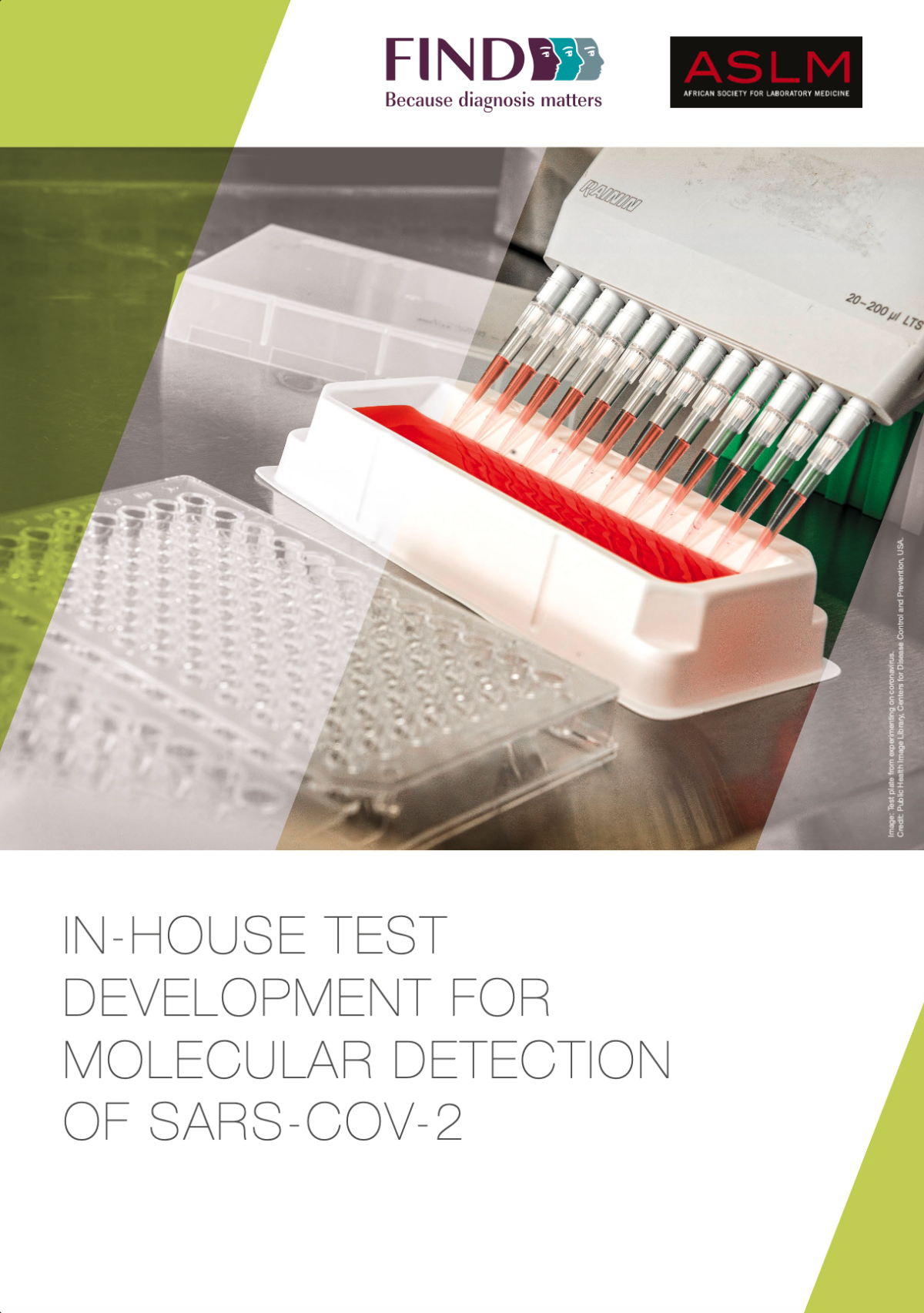
In-house test development for molecular detection of SARS-CoV-2

Roadmap to create diagnostic tests available in English, French and Portuguese.

This document provides guidance on the development of a new, in-house, real-time RT-PCR test for SARS-CoV-2 aimed at laboratories which have established molecular biology capabilities. 

The information – available in English, French and Portuguese – will also provide a roadmap for the creation of new molecular diagnostic tests for other emerging pathogens. 

It acknowledges the constraints  of resource-limited laboratories, and outlines  requirements for good molecular biology practices, including quality control and quality assurance.

Steps to success
When a new virus such as SARS-CoV-2 emerges, laboratories rely on time-tested methods of developing diagnostic tests when commercial assays are unavailable. 

These LDTs are rarely perfect on the first attempt. 

Ideally, these tests continue to develop and gain validation until formally certified for in vitro diagnostic use by a regulatory body.

Most LDTs do not progress to the point of formal certification for use. However, they should still be held to the highest standard of quality possible to mitigate the health and economic impacts of the emerging disease and help protect vulnerable populations.

Read the report here